Paris Air Show 2025

✈️ Paris Air Show 2025: A Mix of Reflection and Renewal
The 2025 Paris Air Show returned with innovation and ambition, but this year’s edition unfolded under a more somber tone. Following the tragic Air India 787 crash that claimed over 240 lives and growing global tensions—particularly in the Middle East—the usually high-energy showcase leaned toward reflection and resilience.

🚀 Commercial Aviation: Airbus Takes the Lead

Despite the subdued atmosphere, Airbus stole the spotlight. The European giant secured around 244 aircraft orders, valued at over $21 billion. Major deals included:

Vietjet: 100 A321neos, with options for 50 more

Riyadh Air: 25 A350-1000s

LOT Polish Airlines: 40 A220s, plus options

AviLease: A mix of A320neos and A350 freighters


Boeing, notably quiet this year, scaled down its presence in light of the Air India tragedy.

🛩️ Regional & Defense Aircraft Make Waves

Embraer made a strong showing:

SkyWest ordered 60 E175s, with 50 more as options

Its military KC-390 transport gained buyers in Europe


Meanwhile, defense took up nearly half the exhibition space—an all-time high. Global conflict concerns fueled interest in UAVs, surveillance drones, and missile systems. New tech like the A330 MRTT+ refueler and upgraded Sikorsky Black Hawks showed how legacy platforms are being adapted for modern, often autonomous, warfare.

🔋 Focus on Green Innovation

Sustainability remained a central theme:

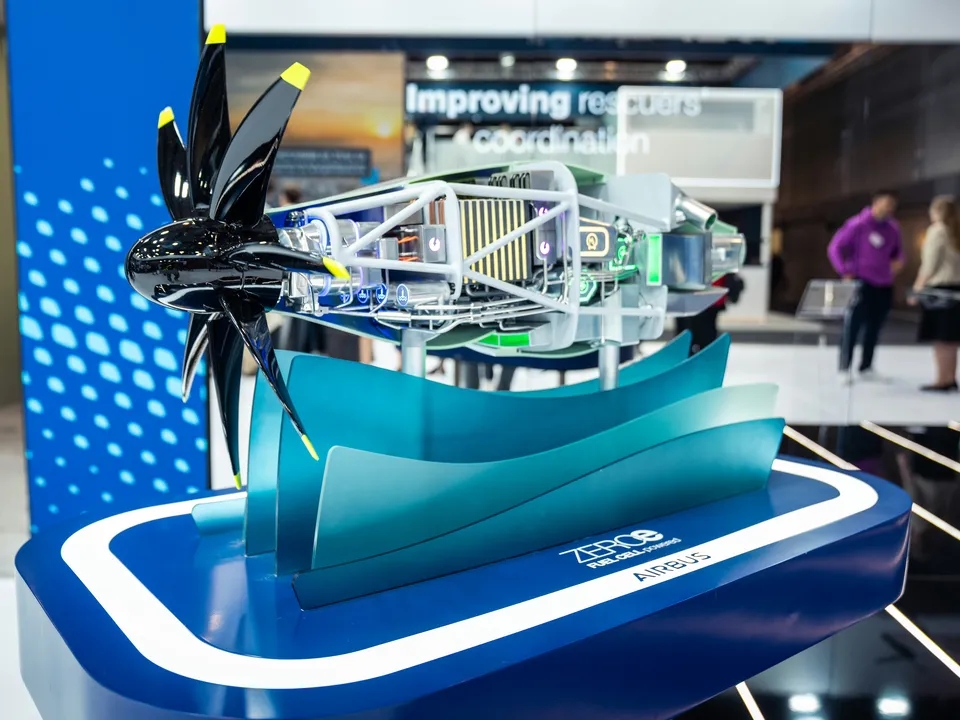
Airbus and MTU showcased hydrogen fuel-cell concepts
Startups launched hybrid-electric regional aircraft

Robotics, like the AEON humanoid, are being tested in aircraft production

Next-gen materials and fast composite molding technologies turned heads on the manufacturing side

📝 Report

This year’s Paris Air Show was a reminder that the aerospace industry is as much about resilience as it is about reinvention. While the mood may have been quieter, the message was clear: the future of flight is here—and it's faster, cleaner, and more defense-conscious than ever.

Popular posts from this blog

Gas Turbine Compressor

PURPOSE OF COMPRESSOR                                     The compressor section of the gas turbine engine has many functions. Its primary function is to supply air in sufficient quantity to satisfy the requirements of the combustion burners. Specifically, to fulfill its purpose, the compressor must increase the pressure of the mass of air received from the air inlet duct, and then, discharge it to the burners in the quantity and at the pressures required.                               A secondary function of the compressor is to supply bleed-air for various purposes in the engine and aircraft. The bleed-air is taken from any of the various pressure stages of the compressor...

Boeing 737

Boeing 737     ·           The Boeing 737 is an American short- to medium-range twinjet narrow-body airliner developed and manufactured by Boeing Commercial Airplanes. ·           Originally developed as a shorter, lower-cost twin-engine airliner derived from the 707 and 727, the 737 has developed into a family of several passenger models with capacities from 85 to 215 passengers. ·           The 737 is currently Boeing's only narrow-body airliner, with the re-engined and updated 737 MAX variant in production. ·           Envisioned in 1964, the initial 737-100 made its first flight in April 1967 and entered airline service in February 1968 with Lufthansa. ·           Next, the lengthened 737-200 entered service in April 1968. ...

GAS TURBINE INLET

The inlet duct of an gas turbine engine is considered to be part of the airframe instead of the engine itself. Nevertheless, the engine inlet is usually identified as station one and is therefore called Engine Station Number One. ·         Air intakes form the first component of all air breathing propulsion systems. ·         The word Intake is normally used in the UK and Inlet in the United States. ·         Air intakes are usually manufactured by the airframe manufacturer in coordination with the engine manufacturer. ·         An aircraft may have one or more intakes depending upon the engine ·         Air intakes are required to capture freestream air, sometimes change its direction and then supply this to the engine. ·         This must be with as little flow disto...